Why parking problems keep coming back on BC properties
Quick Answer
Parking issues on BC strata and rental properties usually return because rules, signage, permits and enforcement are out of sync. Here’s how Royal Parking helps strata councils and property owners across the Lower Mainland build parking systems that actually hold up over time.
Key Takeaways
Root causes of repeat issues
Recurring parking problems usually come from misaligned rules, weak enforcement and outdated permits, not from one difficult neighbour.
Enforcement must be consistent
Structured, documented patrols discourage repeat violations more effectively than occasional crackdowns after complaints.
Digital tools reduce grey areas
Digital registration and clear permit programs give managers an accurate, current record of who is authorized to park.
Signage supports every decision
Visible, consistent parking signage helps residents understand expectations and backs up each enforcement action on the property.
Start with a structured review
A focused review of layout, rules and enforcement exposes specific gaps you can address with tailored parking management.
Recurring parking issues usually share the same root causes
Parking problems keep coming back on BC properties because the rules on paper, the signage on site, and the day‑to‑day enforcement rarely line up for long. Small gaps in that system get noticed and used. Until the whole parking setup is consistent and visible, the same issues tend to resurface in different ways.
At Royal Parking, we see this pattern across strata, rental and mixed‑use properties in Vancouver, Burnaby, Surrey and other Lower Mainland communities. The details of each site differ, but recurring problems usually trace back to a few specific weak spots: unclear expectations, uneven enforcement, and tools that no longer match how residents and visitors actually park.
- Rules are buried in bylaws but not reflected in the lot.
- Permits or digital records are incomplete or outdated.
- Signage is missing, conflicting or worn out.
- Patrols are ad‑hoc rather than structured.
- Short‑term workarounds become permanent habits.
Strata bylaws and house rules drift away from what happens in the lot
Most BC strata and rental properties start with sensible parking rules. Over time, though, exceptions, unwritten agreements and “one‑time” allowances stack up until the real practice no longer matches what the bylaws or tenancy documents say.
That gap creates arguments. One resident points to the bylaws, another points to what people have always done, and visitors are stuck guessing whose version of the rules applies. If residents do not feel the rules are consistent or realistic, many simply stop following them.
Aligning real use with written rules
When we provide residential or commercial parking management, one of the first steps is understanding how the lot is actually used today. We look at resident, staff and visitor patterns across weekdays, evenings and weekends, and compare that to the existing rules and allocations.
From there, we help property managers and strata councils align enforcement policies with their bylaws and operational needs. That can include clarifying which stalls are truly visitor spaces, how loading and fire lanes are handled, and how many vehicles each unit or tenant is authorized to park so that future enforcement is based on clear, agreed‑upon standards.
Weak or inconsistent enforcement teaches people the wrong lesson
Even well‑written rules mean little if they are rarely applied. Many properties see problems fade for a short period after a complaint, only to return once residents realize the response was temporary or limited to a single incident.
Inconsistent enforcement quietly encourages repeat behaviour. If someone parks in visitor stalls every night and nothing happens, that becomes the new norm for them and often for their neighbours. Over months, managers and councils feel like they are constantly reacting instead of running a predictable system.
How structured patrols change the pattern
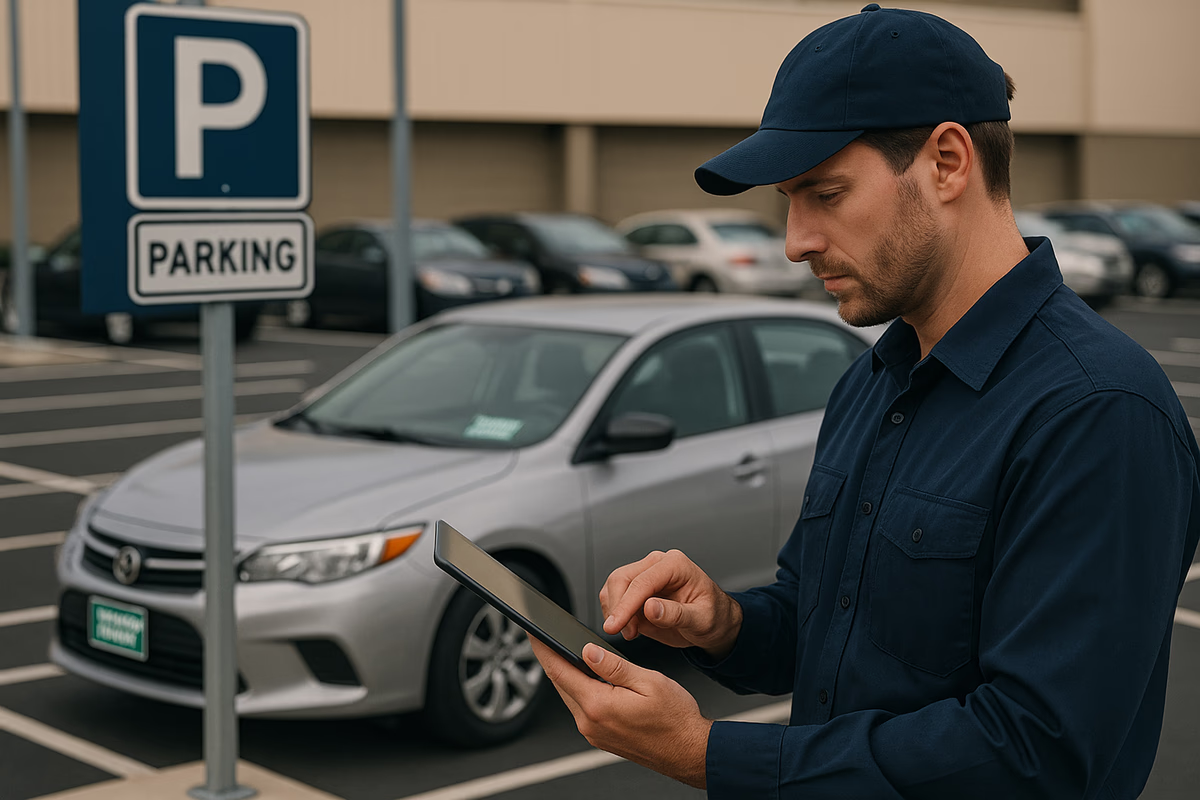
Royal Parking’s on‑site physical patrols follow set procedures instead of relying on occasional spot checks. Our officers focus on defined priorities such as unauthorized vehicles, blocked fire lanes, and misuse of visitor stalls, guided by the property’s rules and layout.
Every enforcement action we take is digitally documented, verified and fully reviewable. Property managers and strata councils across Vancouver, Burnaby, Richmond, Surrey, Coquitlam and North Vancouver can see what is happening in their lots through transparent, real‑time reporting, rather than relying on second‑hand complaints or sporadic photos.
This combination of visible patrols and consistent documentation helps prevent the stop‑start cycle that often causes parking issues to flare up, disappear briefly and then resurface with new tenants or changing resident habits.
Outdated permits and systems leave too many grey areas
Many recurring parking issues trace back to one simple problem: no one is fully sure which vehicles are allowed on site anymore. Paper lists, old decals and informal “I know that car” checks leave room for error and arguments.
On larger residential or mixed‑use properties, staff turnover and resident moves make manual tracking especially difficult. Over a few years, cars belonging to former tenants, employees or long‑term guests can fill spaces that were meant for authorized parkers and short‑term visitors.
Clear identification with physical permit programs
Royal Parking designs and manages physical permit parking programs using decals, hangtags, digital permits and registered permits. Authorized vehicles become immediately identifiable, and enforcement officers can address permit violations or unauthorized parking based on a current, centralized record rather than memory or guesswork.
Digital registration closes the visitor gap
Visitor parking is often where problems flare up fastest. Our digital parking registration lets visitors, tenants and staff register their vehicles in seconds from a smartphone using QR codes or online links, without hardware, kiosks or paperwork.
Each registration ties directly to the property’s parking rules in real time, giving management and officers an accurate record of who should be on site. Digital employee and tenant vehicle registration works the same way, so property managers can see current vehicles without chasing old spreadsheets.
For properties operating free, time‑limited or paid parking, our Appway Mobile Pay Parking system supports ticketless mobile pay and time‑limited stays from a phone, with real‑time parking activity on a single dashboard. This helps keep the on‑site experience and the enforcement tools on the same page.
Signage, layout and safety pressures keep changing
BC properties change over time: new tenants, added accessibility stalls, delivery schedules, ride‑share use and renovations all affect how parking areas function. If signage and markings do not keep up, residents and visitors get mixed messages or no guidance at all.
We frequently see critical areas such as fire lanes, loading zones and visitor stalls signed one way in one corner of the lot and differently in another. In other cases, damage, vandalism or weathering makes important rules unreadable, especially at night or in bad weather.
Matching signs, bylaws and enforcement
Through our parking signage supply and installation services, Royal Parking provides high‑quality signage designed to match the rules a property has chosen and the enforcement program in place. That includes clear visitor parking directions, time restrictions, fire lane markings and permit‑only areas.
Repair or replacement of damaged or vandalized signs is part of keeping the system reliable. Visible, consistent signage reduces confusion, and it also supports enforcement by making the property’s expectations obvious before anyone parks.
Supporting safety and security in busy lots
Parking problems and safety concerns often overlap, especially on mixed‑use or higher‑density residential sites. Through our security services, delivered in partnership with WorldSafe Security Services, we help protect residential, commercial, retail and mixed‑use properties with mobile patrols, incident reporting, access monitoring and response to unwanted activity.
When security and parking management work together, properties can address issues like unwanted activity, vandalism, blocked access routes and other concerns that contribute to an overall sense of disorder in the parking areas.
How Royal Parking helps BC properties break the cycle
If your strata council or property management team feels like parking conflicts never stay solved, you are not alone. The good news is that recurring problems usually point to specific gaps that can be addressed with a structured approach rather than one‑off crackdowns.
| Common issue | Royal Parking solution area |
|---|---|
| Unauthorized resident parking in visitor stalls | Residential Parking Management, Digital Parking Registration, Physical Permit Parking Programs |
| Frequent blocked fire lanes or loading zones | On‑Site Physical Patrols, Parking Signage Supply & Installation |
| Unclear or disputed vehicle authorization | Digital employee & tenant registration, centralized vehicle records |
| Ongoing unwanted activity in parking areas | Security Services with coordinated patrols and incident reporting |
Our structured onboarding process starts with a site assessment, then moves through rule alignment, active enforcement and ongoing compliance reporting. Across Vancouver, Burnaby, Richmond, Surrey, Coquitlam, North Vancouver and surrounding communities, we focus on building parking systems that are transparent, documented and locally managed.
The first practical step is often simply understanding where your current setup is breaking down. If you manage or sit on the council of a BC property that is dealing with repeat parking issues, you can contact Royal Parking to schedule a consultation. We will review your property’s layout, rules and current challenges, then outline a tailored parking management approach so you can decide what level of support makes sense for your community.